Russia’s robust and uncompromising support for Iran in the face of US military adventurism and all-out economic warfare has made it abundantly clear that the strategic partnership between Tehran and Moscow will never be swayed, deterred, or disrupted by outside pressure.
Rather than achieving its intended goal of isolating Tehran, Washington’s aggressive, coercive policies and warmongering have produced the exact opposite effect, acting as a powerful catalyst that has brought Iran and Russia closer together than ever before.
Moscow has repeatedly and forcefully denounced the unprovoked US war on Iran, while flatly dismissing Washington’s economic pressure as an illegitimate tool of Western hegemony. The United States, meanwhile, has sought to aggressively tout the supposed impact of its unilateral sanctions in an obvious bid to distract global public opinion from the strategic failure of its joint military campaign with Israel against Iran, which began six months ago.
In an effort to tighten its economic siege, the administration of President Donald Trump has pressured other sovereign nations to unilaterally sever their legitimate trade and financial relations with Iran under the banner of what the White House has termed “Operation Economic Outcast.” In characteristic hyperbole, Washington went so far as to compare these sweeping sanctions blitz to the historic Allied invasion of Normandy in World War II, theatrically nicknaming it an “economic D-Day.”
On Friday, US Treasury Secretary Scott Bessent declared that the European Union had formally joined Washington’s campaign to completely sever Iran from the global financial architecture. Furthermore, in an interview on Fox News on Wednesday, Bessent blatantly demanded that Russia “stay away” from Iran and abandon its ties with Tehran—a provocative demand that was promptly and decisively rejected by Moscow.
Kremlin spokesman Dmitry Peskov affirmed that Russia will never give up its strategic relations with its long-standing partners to appease Washington. Peskov declared that it is entirely unrealistic for the United States to believe it can monopolize international relations or dictate terms to independent global powers, emphasizing that Russia has its own dependable partners and friends and will vigorously maintain, protect, and expand these friendly and partnership relations regardless of Western hostility.
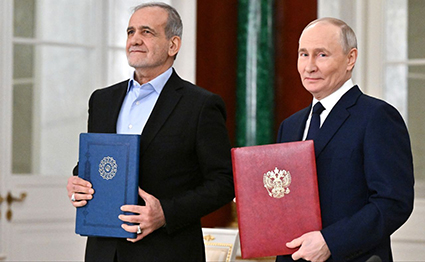
Russian President Vladimir Putin also explicitly and unequivocally expressed Russia’s profound support for Iran during his high-profile meeting with Iranian President Masoud Pezeshkian.
“As I have repeatedly said before, Russia is standing in full solidarity with the people of Iran. We admire your courage and resilience in your fight for your national interests,” Putin told Pezeshkian during their crucial meeting held on the sidelines of the Shanghai Cooperation Organization summit in Kyrgyzstan’s capital of Bishkek. He further noted that the friendly relations between Russia and Iran are developing steadily and dynamically across all areas, adhering strictly to the letter and the overarching spirit of the historic Treaty on Comprehensive Strategic Partnership.
Russia and Iran have significantly and systematically expanded their multifaceted cooperation in recent years, deepening their bonds across a wide and comprehensive range of vital areas, including bilateral trade, energy integration, strategic transportation corridors such as the International North–South Transport Corridor, and advanced defense cooperation. In January 2025, the two countries officially signed the Comprehensive Strategic Partnership Agreement, providing a rock-solid, institutionalized framework for further strengthening bilateral cooperation, neutralizing illegal Western sanctions, and consolidating their joint resistance against unilateralism across multiple strategic sectors.
Moscow’s principled and unyielding stance comes even as CIA Director John Ratcliffe reportedly attempted to intimidate the Kremlin during an unannounced, high-stakes trip to Moscow on Tuesday. Ratcliffe reportedly issued direct warnings demanding that Russia immediately scale down its support for Iran, backing the threat with Washington’s earlier vows to significantly expand extraterritorial secondary sanctions against sovereign countries that refuse to cut their economic ties with Tehran.
Yet, amid mounting Western threats, ultimatums, and economic blackmails, Russia’s position leaves no room for doubt that Moscow regards its strategic partnership with Iran as a permanent, non-negotiable, and long-term priority in the emerging multipolar world order. Rather than bowing to Western pressure or succumbing to Washington’s coercive tactics, Moscow and Tehran are digging in their heels, actively turning mounting Western hostility into an enduring catalyst for deeper, irreversible strategic cooperation. Washington’s desperate efforts to drive a wedge between the two nations have completely backfired, pushing both countries ever closer together on the geopolitical and economic chessboard.
The powerful statements delivered by Putin and Peskov carry immense strategic weight in the wider context of the two-day SCO summit that concluded on Tuesday. SCO leaders—including President Putin, Chinese President Xi Jinping, Indian Prime Minister Narendra Modi, and Pakistani Prime Minister Shehbaz Sharif—collectively signed the “Bishkek Declaration,” which explicitly and unequivocally condemned the joint US and Israeli war of aggression against Iran.
In the joint declaration, the leaders of the Eurasian powers denounced the military aggression as a flagrant violation of the fundamental principles and norms of international law, state sovereignty, and the United Nations Charter, warning that such reckless unilateral actions create grave, unprecedented risks to international peace, regional security, and global stability.
The SCO heads of state also officially expressed their sincere and deepest condolences on the assassination of Ayatollah Seyyed Ali Khamenei, who was martyred on the first day of the joint US-Israeli war on February 28. In his SCO meeting with Pezeshkian, Putin specifically asked the Iranian president to convey his warmest regards and words of sincere, unwavering support to Ayatollah Seyyed Mojtaba Khamenei, who was elected Leader of the Islamic Revolution following the assassination of his father.
Putin’s message of support to Iran’s new Leader is significant in this context. It suggests that Moscow’s backing for Tehran is rooted not in short-term political calculations, but in a broader strategic relationship that Russia is determined to maintain.
https://baranpress.ir/?p=12940